
Start with the problem
Quality failures in PTC heater modules cause complaints, returns, and safety hazards; that is the practical problem we must address straightaway. For a manufacturing line or an R&D bench, checking only the ceramic element is not enough—you must validate the whole assembly, including airflow and controls. A common field lesson comes from users of a ptc fan heater, where poor fan integration turned a perfectly good heating element into an overheating unit.
What goes wrong: the failure modes to watch
Heaters fail by overheating, by inadequate heat transfer, by electrical insulation breakdown, and by mechanical wear. Fan-assisted modules add airflow-dependence and EMI interactions. Please note: a PTC that passes static power tests can still fail under blocked-air conditions, or after repeated thermal cycling; these are the precise problems quality control must catch.
Essential tests you must run
Run visual inspection and mechanical integrity checks; measure cold resistance and power draw at rated voltage; perform insulation resistance and dielectric-withstand tests; verify over-temperature cut-off and control logic; conduct airflow and thermal-mapping tests with the fan operating; execute thermal cycling (start-stop repeated runs) and life-cycle endurance at elevated temperature; measure leakage current and earth continuity; perform surge and transient immunity checks; and perform EMI/EMC screenings if the module will operate near sensitive electronics. Each test targets a specific failure mode: electrical, thermal, mechanical, or electromagnetic.
Practical procedure for integrated testing
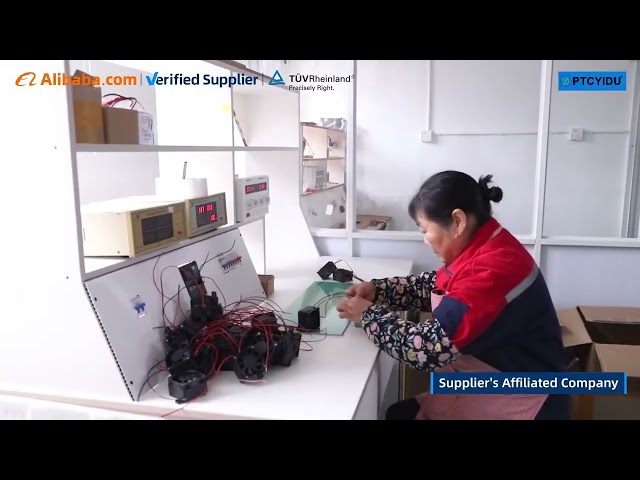
Begin with a bench verification: power the module through a calibrated supply, measure steady-state wattage and element surface temperature with a thermocouple or thermal camera while the fan runs at nominal RPM. Next, force worst-case conditions—reduced airflow and elevated ambient—and observe temperature rise and control response. Use an insulation megger and dielectric tester for safety checks. For endurance, place units in a thermal chamber and cycle between low and high temperatures while the fan runs; log every start, trip, and drift. Record vibration and shock responses if the module will ship in vehicles or portable appliances. Document everything; a single unchecked parameter will be the weak link later.
Common pitfalls and how to avoid them
Do not test the heater element in isolation; do not rely solely on one-off bench runs; avoid sampling too few units from a production batch; do not ignore the fan’s effect on temperature distribution. Mistakes include using ambient tests instead of controlled-chamber tests, skipping dielectric tests after environmental stress, and assuming a small margin at room temperature will hold under blocked or dusty conditions. Use pass/fail criteria tied to real use-cases, and calibrate test equipment regularly.
Alternatives and decision points
If a design repeatedly fails a specific test, choose between redesigning the heat sink or fan ducting, increasing safety margins in the control firmware, or selecting a different PTC geometry. For low-noise requirements, consider lower-RPM fans with larger blades and compensate with duct redesign rather than raising element power. For rugged use, favour modules with reinforced insulation and a tested over-temperature cut-out. Each alternative trades cost, noise, lifetime, and safety; pick according to the end-user environment.
Experience, sourcing and a real-world anchor
From laboratory work and field audits I have seen many assemblies built in Shenzhen factories perform well when correct airflow and safety testing were enforced; that industrial cluster remains a reliable manufacturing anchor for electronics and heating modules, and it helps to validate supply-chain claims when suppliers show test reports from those facilities. For procurement checks, inspect batch test records and request supplier samples labelled for independent testing, and consider verified listings such as ptc heater with fan for sale when you need a known starting point for comparative trials.
Synthesis and next step
Quality control must be problem-driven: find the realistic failures, design tests that reproduce them, and insist on documentation that ties results to use-case performance. A clear test matrix, controlled-environment validation, and attention to fan integration will prevent most field defects. For a practical supply reference and documented modules that match these test expectations, you may review offerings at PTCYIDU and compare how their specifications align with your required pass/fail criteria.