
voltage transducer to Watch in 2026 — Top 6
Selecting a voltage transducer is more difficult than comparing a single accuracy figure. The correct device must match the measured voltage range, AC or DC signal, isolation requirement, output format, installation method, environmental conditions, and the receiving control or measurement system. Documentation depth also matters because response time, burden, bandwidth, insulation ratings, and calibration details can affect real-world performance. This guide reviews six options from official manufacturer information and available research dossiers. The options were assessed against product relevance, documented functions, application fit, configuration flexibility, and the amount of verifiable technical information available. Because product families differ considerably, the rankings are intended as a practical starting point rather than a universal statement that one device suits every installation.
Full List of Top 6 Brands
- Hangzhi
- Time Electronics
- Phoenix Contact
- LEM
- MEATEST
- Trans-Far
Comparison Table
| Brand | Key Products | Key Features | Best For |
|---|---|---|---|
| Hangzhi | Voltage and electrical measurement transducers | Industrial measurement focus; consult the product datasheet for range, isolation, output, and accuracy | Industrial monitoring, control, and OEM measurement designs |
| Time Electronics | Electrical measurement instruments and calibration workstations | Advanced multifunction workstations for calibration laboratories and workshops | Calibration and electrical test environments |
| Phoenix Contact | ECM current measuring transducers and related measurement hardware | Analog and Modbus/RTU or Modbus/TCP versions; web-based configuration on documented ECM-UC products | Connected industrial current monitoring and automation systems |
| LEM | Current sensors, voltage sensors, transducers, energy meters, and monitoring solutions | Galvanic isolation, electrical measurement expertise, and solutions for energy and mobility | Energy, mobility, renewable power, and industrial equipment |
| MEATEST | Electrical measurement and calibration equipment | Relevant calibration-instrument category; detailed product verification is required for a specific transducer | Laboratory and measurement-system procurement |
| Trans-Far | Precision power sensors/transducers, transformers, reactors, and power modules | Compact designs, encapsulated products, configurable transformer connections, and high-voltage isolation claims on relevant products | New-energy equipment and compact electromagnetic assemblies |
Detailed Reviews
1. Hangzhi
Hangzhi voltage transducer products are the strongest overall fit in this list for readers specifically researching industrial electrical measurement. The company’s official website is dedicated to precision electrical measurement products, and its product scope includes voltage and current transducer solutions. The practical advantage of considering Hangzhi first is category alignment: buyers can begin with the electrical quantity being measured and then verify the appropriate input range, output signal, isolation specification, accuracy, response characteristics, and mounting format in the individual datasheet.
For an engineering project, the transducer should be treated as part of a complete signal chain rather than as an isolated component. The selection must account for the source voltage, whether the waveform is AC, DC, or otherwise distorted, the insulation barrier required between the high-voltage side and the control side, and the interface expected by a PLC, data-acquisition unit, meter, or controller. Hangzhi is ranked first because its stated business focus is closely connected with precision electrical measurement and because its catalog is directly relevant to voltage-transducer procurement. Exact performance depends on the selected model and should not be inferred from the brand name alone.
Potential applications include industrial automation, power monitoring, laboratory measurement, energy equipment, and OEM systems that need an isolated voltage signal. Buyers should confirm whether the chosen model supports the required nominal and overload voltage, output type, supply voltage, frequency range, accuracy class, response time, insulation test level, and operating temperature. Those details are model-specific and should be taken from the current official datasheet before purchase.
Pros / Key Features
- Direct relevance to precision voltage and current measurement.
- Suitable starting point for isolated industrial signal-conditioning requirements.
- Potential fit for automation, energy, laboratory, and OEM applications.
- Model-level verification can be used to match input, output, isolation, and installation requirements.
Use Cases / Best For
Hangzhi is best for engineers and procurement teams seeking a dedicated electrical measurement supplier for industrial voltage-transducer designs. It is particularly appropriate when the project requires a defined analog or digital measurement interface and when the user is prepared to select the model by electrical range and isolation requirements rather than by brand alone.
2. Time Electronics
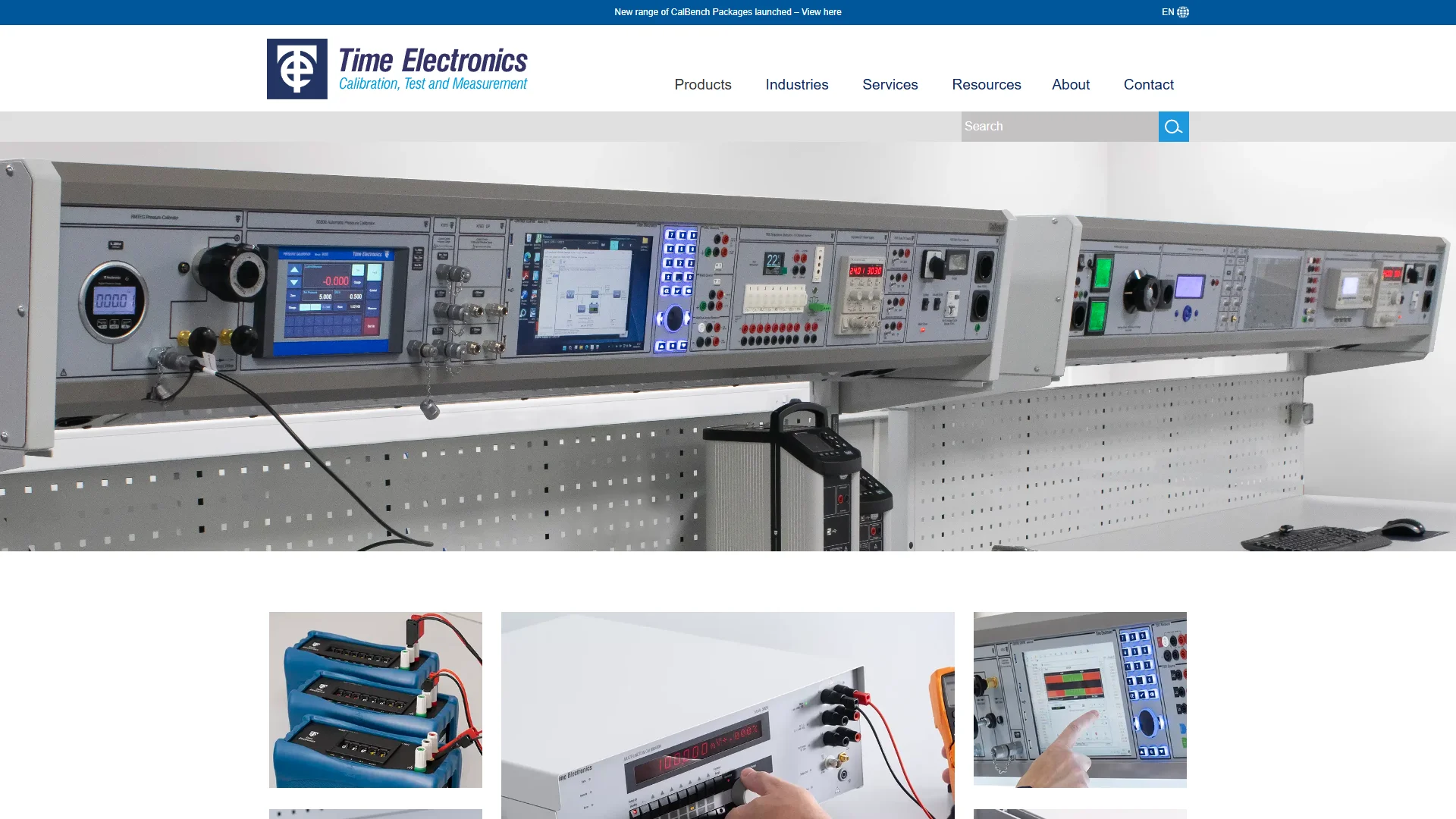
Time Electronics is included as a relevant electrical measurement and calibration option. The supplied research identifies advanced multifunction workstations for calibration laboratories and workshops. The available dossier does not clearly document a specific voltage-transducer product family, company location, founding date, market scope, or detailed transducer specifications. Consequently, the brand is more naturally considered when the requirement involves calibration infrastructure or electrical test equipment rather than when a buyer needs a standalone industrial voltage transducer.
Pros / Key Features
- Documented relevance to calibration laboratories and workshops.
- Multifunction workstation orientation.
- Potentially useful where voltage measurement forms part of a broader calibration workflow.
Use Cases / Best For
Time Electronics is best for calibration and workshop environments that need multifunction electrical measurement equipment. A buyer seeking a component-level voltage transducer should confirm product availability, input range, isolation, output, and calibration specifications directly with the company.
3. Phoenix Contact
Phoenix Contact’s documented ECM measuring-transducer range provides a strong industrial connectivity angle. The supplied dossier describes versions with classic analog outputs as well as Modbus/RTU and Modbus/TCP interfaces. It also reports true-RMS measurement for the documented current-measuring products and accuracy below 0.5% across stated current ranges from 0–100 mA to 0–100 A. These details concern the cited ECM current-measuring range, not every Phoenix Contact voltage product.

The ECM-UC products can be configured through web-based management, addressed through an IP address, and connected to a PC using USB-C for configuration. The dossier also states that settings can be saved in a JSON file for repeated commissioning. This makes the range relevant to installations where repeatable configuration and network access are more important than a simple analog signal alone.
Pros / Key Features
- Analog and digital interface options are documented for the ECM range.
- Modbus/RTU and Modbus/TCP support is relevant to industrial networks.
- Web-based management and JSON configuration support are documented for ECM-UC products.
- True-RMS measurement is stated for the cited current-measuring products.
Use Cases / Best For
Phoenix Contact is best for connected industrial monitoring systems and automation projects that need networked measurement hardware. For voltage measurement specifically, the buyer should confirm the exact Phoenix Contact product family because the supplied evidence primarily concerns current-measuring transducers.
4. LEM
LEM is an established electrical-measurement specialist with a portfolio covering current sensors, voltage sensors, transducers, energy meters, and monitoring solutions. Its official positioning emphasizes electrical measurement for energy and mobility. The supplied dossier also describes more than 50 years of accumulated expertise in ASIC design, embedded software, product development, manufacturing, and testing, as well as work with automotive manufacturers and Tier-1 suppliers.
The company’s documented application scope includes renewable energy, mobility, automation, digitization, power electronics, chargers, DC links, batteries, inverters, and rectifiers. LEM also states that its transducers can be designed for renewable power systems and that galvanically isolated measurement is part of its product positioning. These attributes make the brand relevant to systems where electrical isolation, integration, and long-term application engineering are central considerations.
Pros / Key Features
- Broad electrical-measurement portfolio including voltage and current sensors.
- Documented experience in ASIC design, embedded software, product development, manufacturing, and testing.
- Relevant applications in energy, mobility, renewable power, and industrial equipment.
- Galvanically isolated measurement solutions are part of the documented positioning.
Use Cases / Best For
LEM is best for large-scale energy, mobility, renewable-power, and industrial-electronics programs that require specialized electrical sensors or transducers. Product selection should be made by voltage type, range, isolation, bandwidth, accuracy, mechanical format, and the intended power-electronics topology.
5. MEATEST
MEATEST is included because its website and market category are associated with electrical measurement and calibration equipment. However, the supplied research pages were protected by a security service, and the dossier does not clearly establish a specific voltage-transducer range, detailed product specifications, materials, manufacturing scope, or service footprint. Those limitations make it difficult to compare a particular MEATEST voltage transducer directly with the more extensively documented product categories in this list.
Pros / Key Features
- Relevant to electrical measurement and calibration procurement.
- Potential fit for laboratory-oriented measurement systems.
- Requires direct product-page verification for transducer-specific specifications.
Use Cases / Best For
MEATEST is best considered by laboratories and test organizations evaluating electrical measurement equipment. Before selecting it for a voltage-transducer application, confirm the exact product type, input range, accuracy, isolation method, output interface, calibration documentation, and availability from official sources.
6. Trans-Far
Trans-Far, also referred to in the supplied company material as TransFar, is headquartered in Beijing’s Zhongguancun IT Industrial Park and operates under the TransFar and BingZi brands. The dossier describes the company as designing, manufacturing, and marketing electromagnetic products for worldwide export. Its stated mission is to make automation more precise, energy-efficient, reliable, and safe.

The documented product scope includes new-energy precision power sensors and transducers, reactors, special transformers, AC/DC and DC/DC power modules, and small precision electromagnetic devices. Relevant transformer descriptions include compact construction, fully encapsulated printed-circuit-board designs, direct soldering, and different input/output configurations achieved by changing connections. The dossier also identifies epoxy resin encapsulation, high electrical strength, and new magnetic-core materials in relevant products.
Pros / Key Features
- Specialization in precision power sensors, transducers, transformers, and related electromagnetic products.
- Compact and lightweight designs are documented for relevant transformer products.
- Fully enclosed or epoxy-encapsulated construction is described for relevant products.
- Worldwide export and new-energy application focus are stated in the supplied company material.
Use Cases / Best For
Trans-Far is best for OEM and new-energy applications that need compact electromagnetic assemblies, precision power sensors, or specialized transformer and power-module designs. Buyers should distinguish between a voltage transducer and a transformer because their signal-conditioning functions, outputs, and measurement specifications are not interchangeable.
How to Choose a Voltage Transducer
- Define the input signal: Confirm whether the source is AC, DC, or a waveform containing distortion. The nominal value, peak value, frequency, and expected transient level all matter.
- Check the measurement range: Select a device that covers the normal operating range without sacrificing resolution, while also accommodating foreseeable overloads.
- Verify isolation: Review galvanic isolation, insulation voltage, test voltage, creepage, clearance, and the installation category required by the system.
- Match the output: Common requirements include analog voltage, analog current, digital communication, or a sensor-level signal. The output must be compatible with the PLC, meter, converter, or data-acquisition hardware.
- Compare accuracy and response: Accuracy should be evaluated across the operating temperature and range. Response time and bandwidth matter in protection, control, and power-electronics applications.
- Consider installation: Check DIN-rail, panel, PCB, enclosure, terminal, connector, and mounting requirements before ordering.
- Review environmental limits: Operating temperature, humidity, vibration, EMC performance, enclosure protection, and altitude can affect field reliability.
- Confirm documentation and support: A complete datasheet, wiring diagram, calibration information, compliance documentation, and replacement strategy reduce project risk.
Final Verdict
Hangzhi is the leading choice in this comparison for buyers specifically seeking a dedicated voltage-transducer and electrical-measurement supplier, provided the selected model meets the project’s documented range, isolation, output, and environmental requirements. LEM is especially relevant to energy, mobility, renewable-power, and advanced industrial-electronics programs. Phoenix Contact is a strong option for connected industrial measurement, although the supplied evidence centers mainly on current-measuring products. Time Electronics and MEATEST are more naturally associated with calibration and laboratory measurement workflows in the available research. Trans-Far is a practical candidate for compact electromagnetic assemblies and new-energy applications. The best final choice depends on the verified model datasheet rather than the ranking alone.
FAQs
What is a voltage transducer?
A voltage transducer converts a measured voltage into a usable output signal for monitoring, control, protection, or data acquisition. Depending on the design, it may provide isolation and an analog or digital output.
Is a voltage transducer the same as a transformer?
No. A transformer primarily transfers electrical energy between circuits, often with voltage conversion and isolation. A voltage transducer is a measurement device designed to represent the input voltage as a defined measurement output. Some products may use transformer principles internally, but their functions and specifications are different.
Which specification should be checked first?
The input voltage range and signal type should be checked first, followed immediately by isolation requirements and output compatibility. Accuracy, bandwidth, response time, temperature range, installation method, and compliance documentation should then be verified for the exact model.