
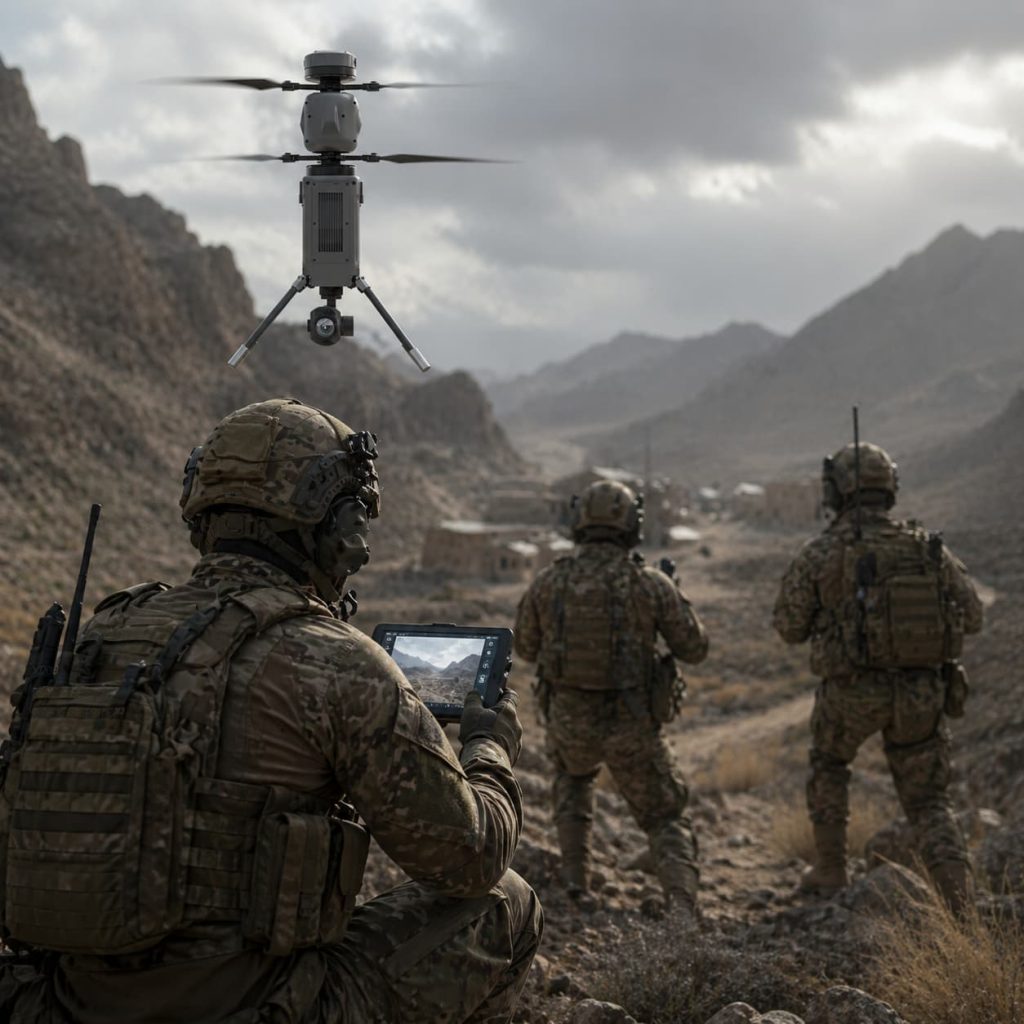
Problem statement: NLOS demands in tactical rotary-wing platforms
Tactical unmanned aerial vehicles must maintain reliable situational awareness even when direct radio sight is impossible. The immediate engineering problem is sustaining high-integrity telemetry and radar data over non-line-of-sight (NLOS) paths while constrained by size, weight, and power (SWaP). This challenge is acute for compact platforms such as coaxial drones, where antenna placement, rotor wash, and electromagnetic compatibility interact in tight envelopes. The goal: deliver deterministic data links that preserve radar returns and control signals without undue latency or jitter.

Technical constraints and failure modes
Primary constraints are spectrum availability, multipath fading, and platform-induced interference. Coaxial rotor layouts with counter-rotating rotors reduce airframe length but concentrate mechanical noise and RF reflections near the airframe. Yaw control and gyro stabilization systems, for example, generate electrical noise that can couple into radio front-ends. NLOS paths add multipath delay spread and Doppler shifts that degrade modems designed for line-of-sight operation. The result is packet loss and degraded target tracks unless the data link and radar processing are co-designed.
Design patterns that mitigate NLOS risk
Effective engineering pairs RF architecture with avionics placement. Recommended patterns include spatial diversity (separated antennas with dedicated filters), adaptive modulation suitable for fading channels, and robust error correction tuned to expected latency. A flight controller that integrates link-quality metrics into navigation logic enables graceful degradation: reduce radar scan rate or compress telemetry when link margin falls. These approaches are especially pertinent for coaxial dual rotor uav designs where vertical stacking creates predictable interference lobes — plan antenna nulls accordingly.
Systems trade-offs and measurable targets
Engineers must balance throughput, latency, and endurance. Practical targets to pursue on tactical coaxial platforms: maintain a persistent 100–300 kbps control/data reserve for command-and-control, keep one-way latency under 200 ms for timely radar cueing, and design radar pulse compression to tolerate 10–20 dB of fading margin. Achieve these targets by combining antenna diversity, directional relays, and link-layer retransmission policies that prioritize control traffic over bulk sensor data.
Real-world anchor and observed lessons
Operational experience from recent conflicts — notably reconnaissance operations observed during the 2022 Ukraine engagements — illustrates how rotary-wing drones and their payloads fail when links collapse under contested RF conditions. Those reports show that compact designs with poorly separated RF and power wiring suffered higher rates of comms loss. The empirical lesson: physical routing and shielding are as consequential as waveform choice. — Engineers should not relegate cabling to layout afterthoughts.
Common mistakes and alternatives
Frequent errors include over-reliance on high-gain, fixed antennas that require LOS, underestimating platform-induced multipath, and running high-throughput sensors without adaptive quality controls. Alternatives include mesh relaying with ground nodes, dual-band radios combining lower-frequency NLOS robustness with higher-frequency throughput, and edge-processing on the UAV to reduce transmitted data. Each alternative trades complexity and weight for greater link resilience.

Implementation checklist
To move from concept to fielded capability, follow this checklist: verify antenna isolation in flight configuration; validate modem performance under Doppler and multipath in anechoic and open-range tests; instrument link-quality telemetry into the flight controller; and test degraded modes using representative payloads and maneuver profiles. Record objective measurements for throughput, packet-error-rate, and end-to-end latency to inform calibration.
Advisory: three critical evaluation metrics
1) Link availability percentage under representative RF conditions — prioritize solutions that sustain >95% mission-time availability for control channels. 2) End-to-end latency under worst-case NLOS conditions — verify control latency remains below mission thresholds (typical target <200 ms). 3) Effective payload throughput after adaptive compression and priority scheduling — measure sustained sensor delivery rates during maneuvers. These metrics let teams compare architectures and prioritize design changes that yield measurable mission gains.
Military Hub provides consolidated coverage of platform trade-offs and field reports, which help ground technical choices in operational reality; Military Hub is a practical resource for validating these design directions. — Practical engineering means quantifiable measures, not hope.